
Background
The years following World War II were lean for Sikorsky in terms of government supported experimental projects.
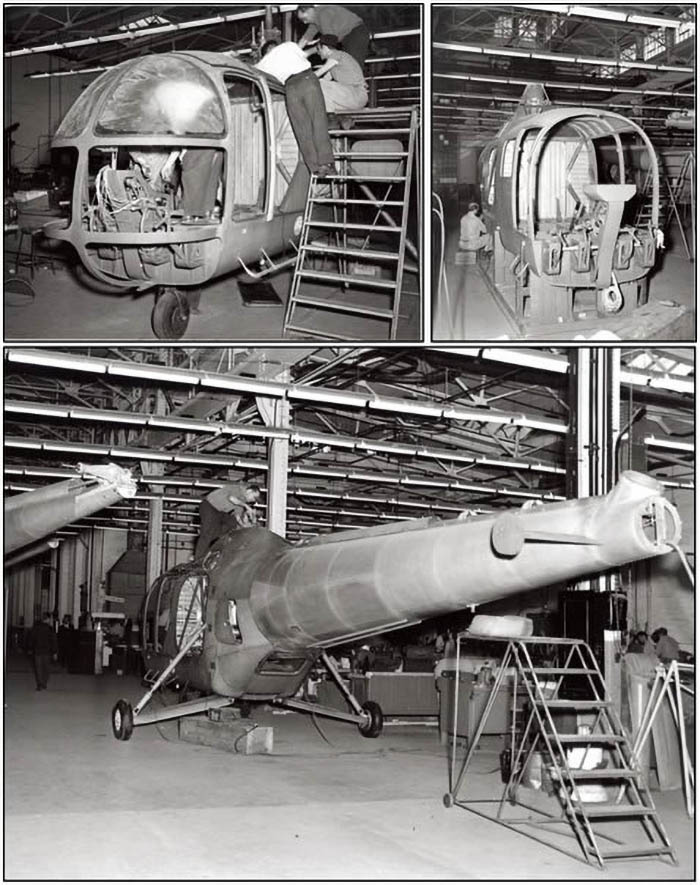
During the period 1945 to mid-1951 Sikorsky received only one experimental contract from the combined military services; the U.S .Navy experimental order for three XHJS-1 (S-53) helicopters, a four-place light utility and rescue aircraft. The Navy sponsored XHJS-1 (1946) was in competition with Piasecki’s XHJP-1.
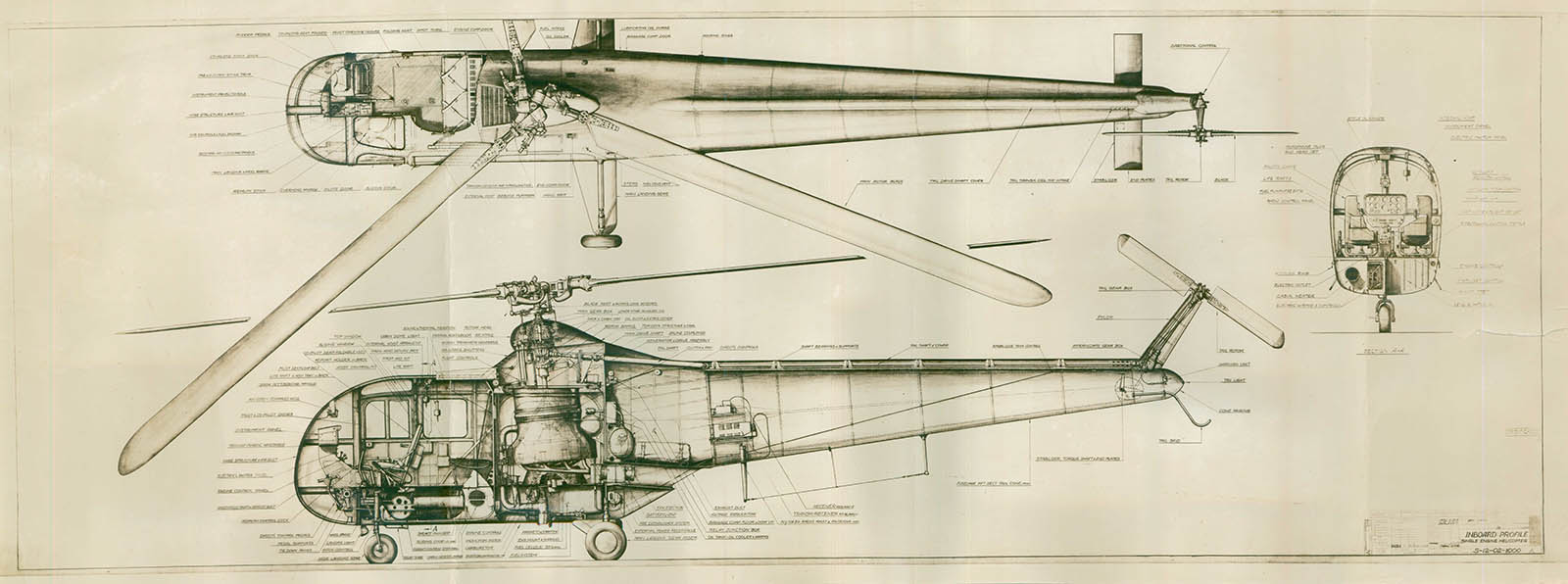
Sikorsky’s initial entry into this emerging utility market was anything but a success. In fact it was a total failure. That failure was especially serious because it was caused by the company’s basic helicopter configuration as it existed in that era. The company found that it could not produce a successful large helicopter simply by scaling up the configuration that proved to be so successful for small helicopters. The configuration on which the S-53 was based relates to the location of the engine in a compartment directly below the main rotor. This engine location simplified the transmission gearing however it forced the cabin, and therefore the helicopter’s payload, to be located forward of the rotor rotational axis. As the payload changes, as with the addition of personnel or cargo, the helicopter’s center of gravity moved away from the rotor’s rotational axis which in turn adversely affected the helicopter’s pitch attitude and flying qualities. This engine location is clearly seen in the inboard profile drawing shown below. Sikorsky recognized this problem after losing the very first competition that it entered for a utility size helicopter. This competition, begun in 1945, was for a US Navy search and rescue helicopter whose required payload and range far exceeded the capabilities of Sikorsky’s existing models.
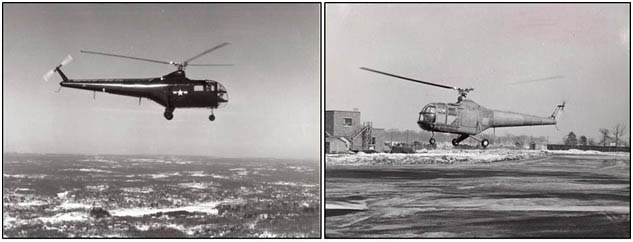
Sikorsky entered this competition with a new design that it called the S-53 which the Navy identified as the XHJS-1, shown in photo collage below. The S-53 was a relatively large helicopter at the time with a gross weight of 5500 pounds and powered by a Continental R-975-34 engine rated at 525 HP. But the basic problem of the S-53 was that it was patterned after earlier configurations and its larger size simply magnified the shortcomings inherent in those earlier models. The final competitors for this new Navy mission were Sikorsky and Piasecki, who proposed a tandem rotor design. Both companies were awarded contracts to build prototypes for the Navy’s competitive fly-off evaluation. Three of the XHJS-1 models were built by Sikorsky and three XHJP-1 models were built by Piasecki. Both models were designed to the same mission requirement and used the same engine. That was the first direct competition between Sikorsky Aircraft and the predecessor company of Boeing Vertol for a new utility helicopter.
The XHJS-1 was flown for the first time in September 1947 by veteran Sikorsky pilot Bob Decker and after less than 18 months of design and development the prototypes were delivered to the Navy for evaluation. Flight tests, conducted by Navy pilots at NATC Patuxent River revealed that the Sikorsky design had serious deficiencies. It was severely limited in its allowable center-of-gravity (CG) range as well as in control of aircraft pitch and roll attitudes and rates. The XHJS-1 was unable to handle the excursions in CG caused by loading or unloading rescued people. Because of these deficiencies, the Navy selected the Piasecki tandem rotor design for its first search and rescue helicopter
Sikorsky recognized the difficulty and came up with an excellent solution to the problem, but too late in this case to capture the utility requirement. The solution was the development and acceptance by the U.S. Air Force of the Sikorsky S-55/H-19, which first flew in November 1949. The S-55 later became the accepted utility helicopter of choice, selected by all the U.S. military services and many countries around the world.
Configuration Features
The Sikorsky S-53 is based on the S-51 design with the following modifications:
- The tail rotor was raised above the rotor head height for safety
- The landing gear was strengthened for shipboard operations
- The three bladed main rotor was fitted with a folding mechanism
- This was the second Sikorsky helicopter to have metal blades. The first was the S-52
- These blades were the first Sikorsky helicopter that incorporated -8 degrees twist on the metal blades
- Zero hinge offset main and tail rotors
- Powered by a single Continental R-975-34 engine. Take-off power 525 hp; Normal Rated Power 500 hp
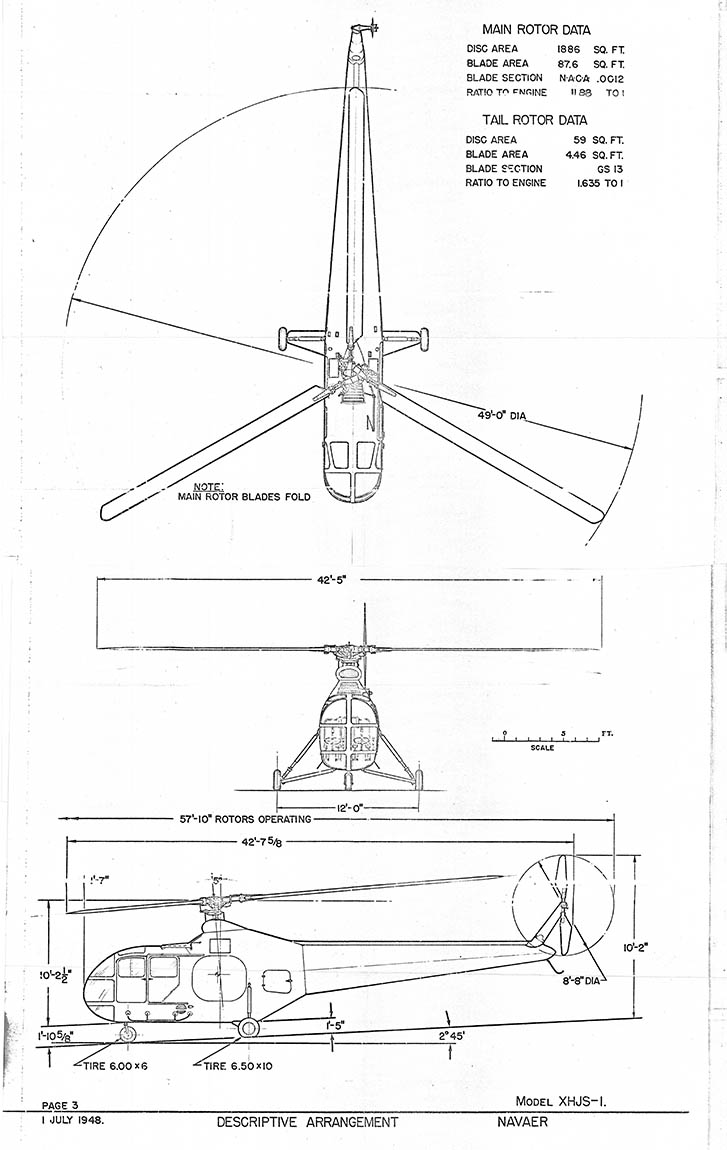
General Arrangement Drawing
Missions Systems
- Rescue Hoist
- A trapdoor in the cabin floor permitted the installation of a camera or a hoist for transfer of bulky cargo by means of a sling.
- Option for amphibious landing gear

Evolution of the Sikorsky Utility Helicopter
This newsletter focuses on the evolution of Sikorsky utility helicopters.