
Background
With the success of the experimental S-60 flying crane helicopter Sikorsky received corporate approval to proceed with the development of a production prototype, the S-64 Skycrane. This was to be more powerful than the S-60 and use turbine engines rather than the piston engines of the S-60. The basic mission was heavy cargo transport, with quick, safe and efficient turn-around time due to the external cargo configuration. This mission was later expanded to include a method of internal transport, particularly of troops, using a pod attached to the underside of the aircraft.
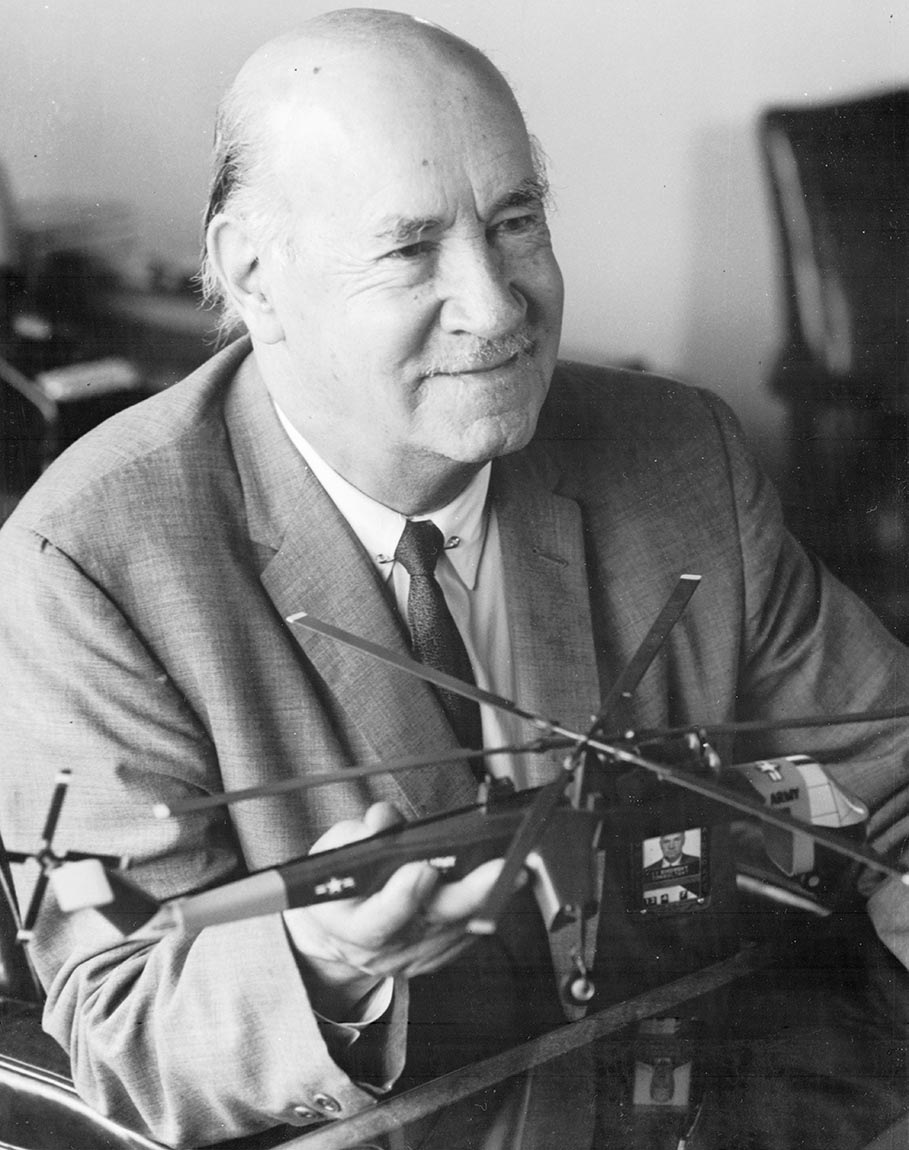
First flight of the S-64 was on May 9, 1962, only 13 months from program go-ahead. Only two months later, in July 1962 the aircraft was flown to Ft. Benning Georgia for Army evaluation. Up to this time, everything was company funded.
The U.S. Army bought six S-64s for evaluation at a cost of $13 million. They designated it the CH-54A Tarhe. Four of these aircraft eventually went to Vietnam to assist in the war effort. The German government also bought two for evaluation. A U.S. Army production order followed the initial Vietnam evaluation. The Germans did not buy any Skycranes, preferring the CH-53A with its internal cabin.
Initially the aircraft were designated the S-64A. With a production order from the Army, including numerous configuration and performance changes, including wider chord blades, the aircraft were designated the CH-54A by the Army and the S-64E in Sikorsky terminology. After a number of years of production, the mission capabilities were expanded again with the CH-54B/S-64F configuration.
Configuration Features
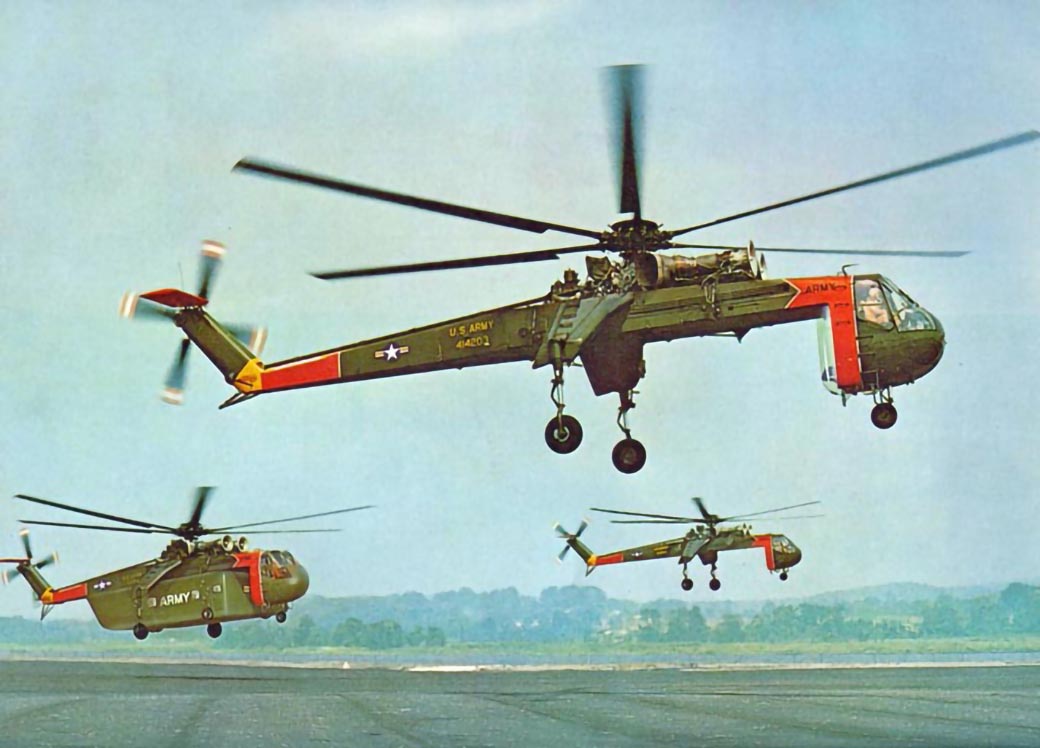
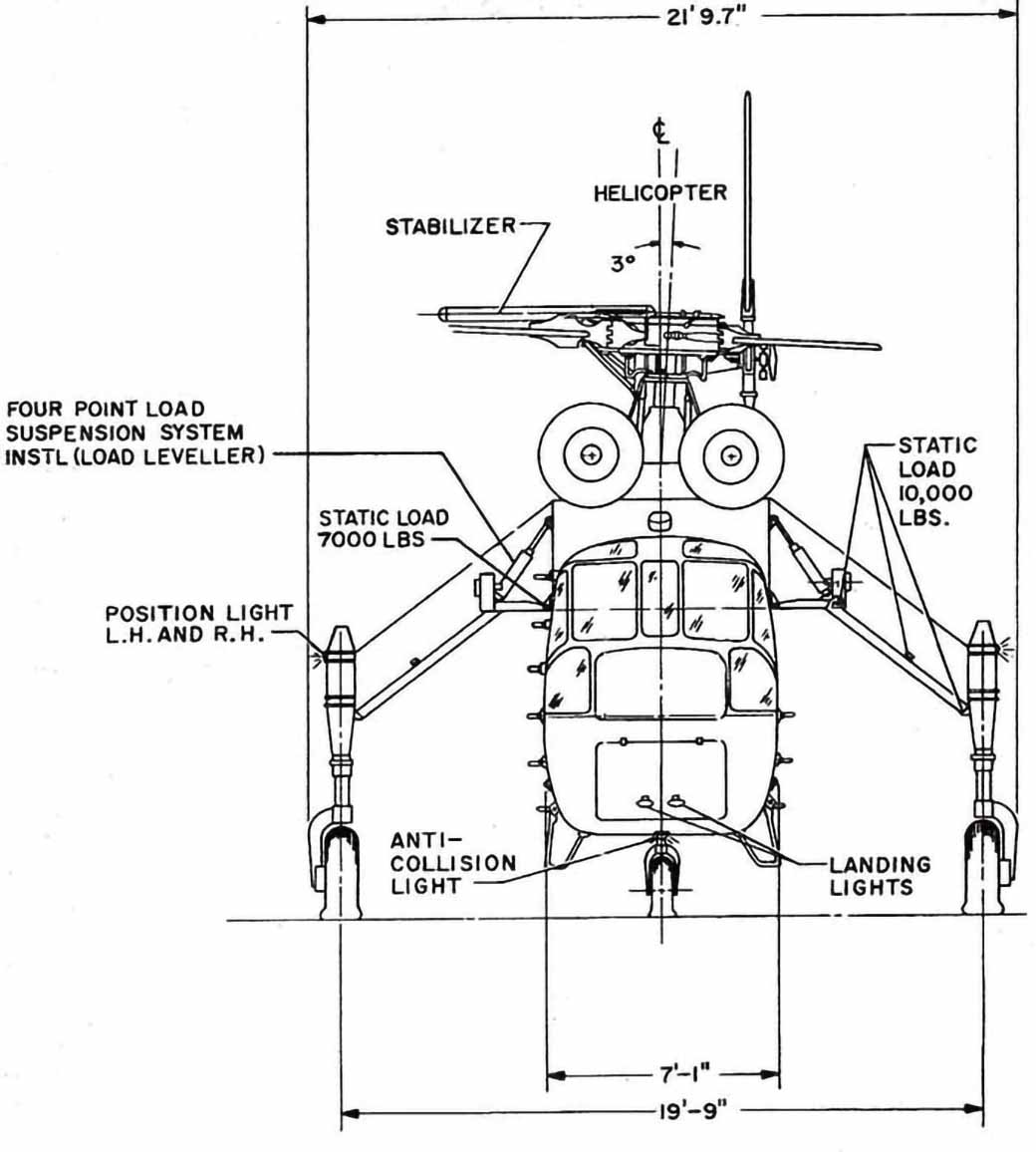
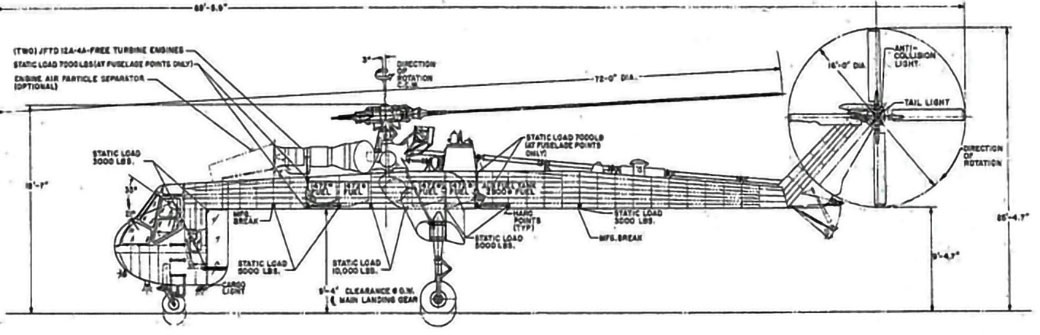
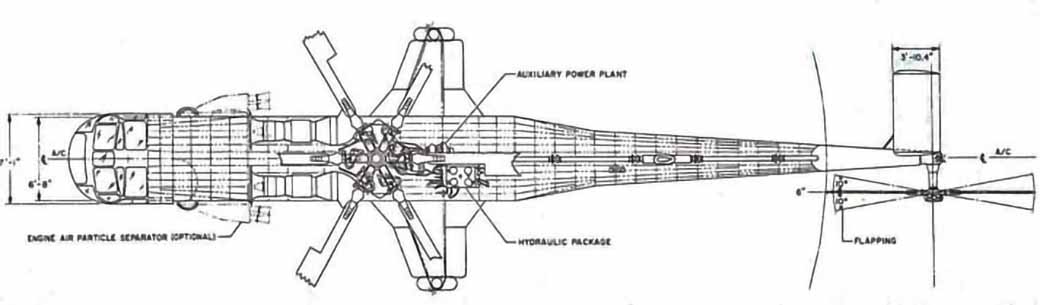
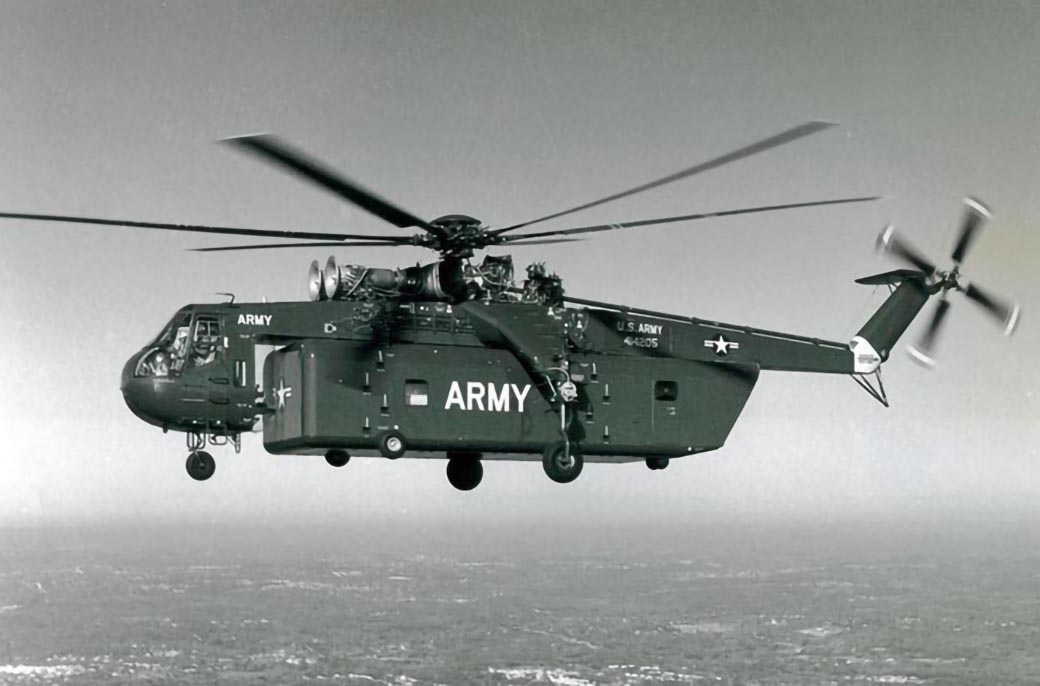
Like the S-60 before it, the main feature of the S-64 Skycrane was its basic configuration with no cabin, just a simple “stick” fuselage designed to carry cargo externally. Two Pratt & Whitney JFTD-12 turbine engines were used with a new dynamic system. The 72 foot diameter rotor was derived from the S-56/S-60 with a sixth blade added, plus additional blade chord for increased blade area. A tricycle landing gear with a nose wheel and main landing gear aft configuration, opposite to what was used on the S-60, was chosen to ease ground maneuvering around the payload. This was one of the lessons learned from the experimental S-60 program. A tail skid was included to protect the tail in an extreme nose up landing. The cockpit was below the structure and included a third pilot’s station facing aft to be used to fly the aircraft as it attached and released the payload. The cockpit was sized to carry a crew of five – the pilot, copilot, aft-facing pilot, and two mechanics. Since the aircraft was designed to operate for extended periods in remote areas, it was decided to include space for the two mechanics onboard the aircraft. One other interesting feature is the lack of cowlings over the dynamic system hardware. Since speed, and therefore drag reduction, was not a requirement, it was decided to simplify maintenance access, reduce weight and save production costs by not using these cowlings.
The transmission is tilted 3 degrees to the left and not tilted forward. This allows it to hover level over the load being picked up. As a result of this, in cruise flight the cockpit is tilted to the right and theaircraft flies with a nose down attitude.
General Arrangement Drawing
Mission Systems
The aft-facing cockpit was included to ease picking up and releasing the cargo loads. Unlike the experimental S-60, it did not use a rotating pilot’s seat for the aft pilot’s station. The S-60 had shown that a separate aft pilot’s station was preferable. The S-64 aft pilot’s station is believed to be the first use of fly-by-wire controls on a helicopter. There were two modes. In one the pilot controlled the aircraft through the SAS servos, which gave fine control but limited authority. In the other mode, he put inputs into the autopilot (trim) servos. This allowed full amplitude control, and moved the front sticks so that the pilots knew what was going on. They could override the trim servos since they were connected to the sticks by springs and magnetic brakes.
A 20,000 pound capacity cargo hoist was included for single point suspension of the cargo load. This allowed the load to be moved up and down while the aircraft was stationary. The hoist cable was fed to the drum by a compensator linkage that automatically added or reduced collective pitch to help hold vertical position. Additionally there was a system of four small hoists of 5,000 pound capacity each to support the cargo in a different configuration. To further improve cargo handling on the ground, the landing gear could kneel over the load to facilitate attachment and detachment.
Various cargo/personnel pods were also designed and fabricated for internal cargo, personnel transport, medical, and maintenance purposes. In May 1965, the crane demonstrated transport of 90 troops using the cabin pod.
Other Representative Missions
General Characteristics and Performance
| S-64A | S-64E CH-54A | S-64F CH-54B |
|
|---|---|---|---|
| Design Gross Weight | 38,000 lbs | 38,000 lbs | 47,000 lbs |
| Overload Gross Weight | 41,000 lbs | 42,000 lbs | N/A |
| Weight Empty | 17,240 lbs | 19,120 lbs | 19,700 lbs |
| Useful Load | 20,760 lbs | 22,880 lbs | 27,300 lbs |
| Payload | 16,000 lbs | 20,000 lbs | 25,000 lbs |
| Rotor Diameter | 72 ft | 72 ft | 72 ft |
| Blade Chord | 1.97 ft | 1.97 ft | 2.167 ft |
| Blade Twist | -13º | -13º | -14º nonlinear* |
| Tail Rotor Diameter | 16 ft | 16 ft | 16 ft |
| Tail Rotor Chord | 1.28 ft | 1.28 ft | 1.28 ft |
| Length | 88 ft 6 ins | 88 ft 6 ins | 88 ft 6 ins |
| Height | 25 ft 5 ins | 25 ft 5 ins | 25 ft 5 ins |
| Powerplant | Two P&WA JFTD-12A-1 | Two P&WA JFTD12A-4A | Two P&WA JFDT12A-5A |
| Engine Power | 4,050 hp | 4,500 hp | 4,800 hp |
| Transmission Limit | 5,400 hp | 6,600 hp | 7,900 hp |
| Crew | 3 | 3 | 3 |
| Maximum Cruise Speed | 102 knots | 115 knots | 104 knots |
| Range | 166 nm | 217 nm | 208 nm |
| Hover Ceiling, In Ground Effect | 9,700 ft | 10,600 ft | |
| Service Ceiling | 10,500 ft | 13,000 ft | |
| Rate of Climb | 1,400 ft/min | 1,700 ft/min |
*With its nonlinear 14º twist, the S-64F had the highest figure of merit (.73) of any Sikorsky rotor up to that time. For comparison the CH-53 had a figure of merit of .69. The downside was that the S-64F was speed limited to 110 knots due to high stresses at speed caused by the high twist. This was acceptable to the Army because its mission was to carry external loads, not to achieve high speeds.
With the simple light weight fuselage configuration, the cranes had very low empty weight to gross weight ratios, as low as .42 on the
S-64F. Without payload this gave the aircraft outstanding performance. Numerous altitude and time-to-altitude records were broken by the Skycranes. In level flight the S-64F flew at 36,122 feet.
Hover Records
| Payload | Maximum Altitude |
|---|---|
| 4,410 lbs | 31,480 ft |
| 11,025 lbs | 25,510 ft |
| 22,050 lbs | 17,212 ft |
| 33,075 lbs | 10,850 ft |
Time to Climb Records
| Altitude | Time to Climb |
|---|---|
| 9,843 ft | 1 min 22.2 sec |
| 19,686 ft | 2 min 58.9 sec |
| 29,529 ft | 5 min 57.7 sec |
Production History
United Aircraft Corporate approval for the design and development of the S-64 was given in April 1961. Up to the first flight on May 9, 1962 everything was company funded. In June 1963 the U.S. Army bought the six S-64s for evaluation. The FAA Type Certificate was granted on July 30, 1965. The CH-54B configuration production began in 1969.
Production by Year
| Year | Quantity |
|---|---|
| 1962 | 1 |
| 1963 | 1 |
| 1964 | 6 |
| 1965 | 0 |
| 1966 | 2 |
| 1967 | 22 |
| 1968 | 30 |
| 1969 | 13 |
| 1970 | 12 |
| 1971 | 7 |
| 1972 | 0 |
| 1973 | 1 |
| 1974 | 1 |
| 1975 | 3 |
| Total | 99 |
54 CH54As and 35 CH-54Bs for the Army, and 12 S-64Es and Fs for commercial customers (two aircraft were returned, refurbished, and resold).
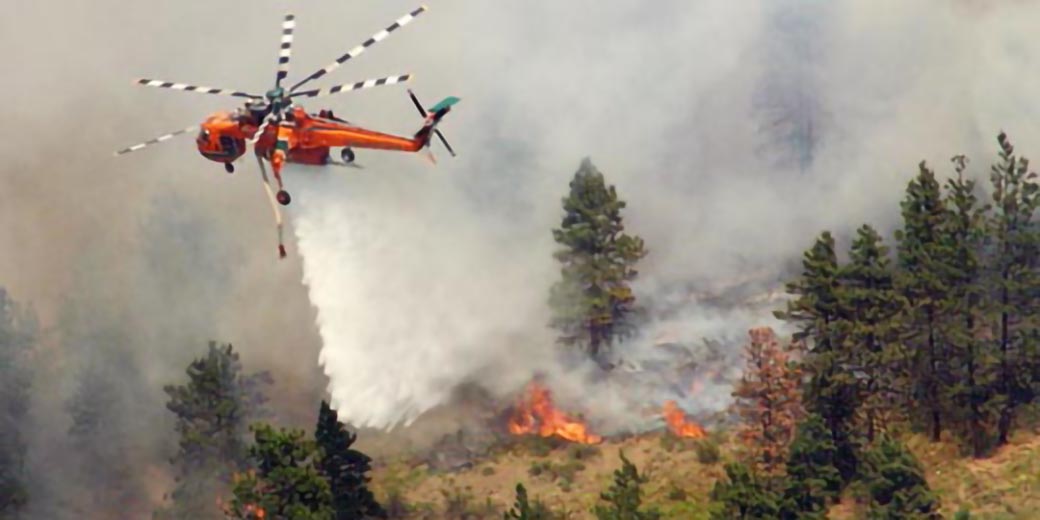
Sikorsky also launched an effort to sell the S-64 commercially. A total of ten Skycranes were sold or leased to commercial customers between 1968 and 1976. Seven of these were sold to Ericson Air-Crane, Inc. of Medford Oregon for logging operations and some firefighting and construction activity. By the 1980s forest firefighting became the main mission for the Ericson cranes.
In 1992 Sikorsky agreed to sell the Skycrane Type Certificate to Ericson. This transferred all manufacturing and support rights worldwide to Ericson for both the S-64E, with a 10-ton payload, and the S64F, with 12.5-ton payload. Ericson built up a fleet of S-64s rebuilding army surplus CH-54As and CH-54Bs. Their fleet rose to 18 aircraft by 2000. Additional Ericson Air-Cranes have been sold internationally. They continue in use today.
The CH-54s were retired from Army service in 1995.
Related Models
In 1968 Sikorsky proposed a growth crane to the Army, the S-64B, which used a 79 foot rotor and three engines with a new main gearbox. Originally both the General Electric T-64-GE-16 and the Lycoming T-55- l-11 were proposed. The design was for a payload of 17.9 tons, with a design gross weight of 50,000 lbs and an overload gross weight of 64,700 lbs. Weight empty was 26,669 lbs; maximum speed was 100 knots with payload and 130 knots without payload. This concept was not pursued beyond the proposal stage, but the three engine/79 foot rotor became the basis of the CH-53E, using the General Electric engines
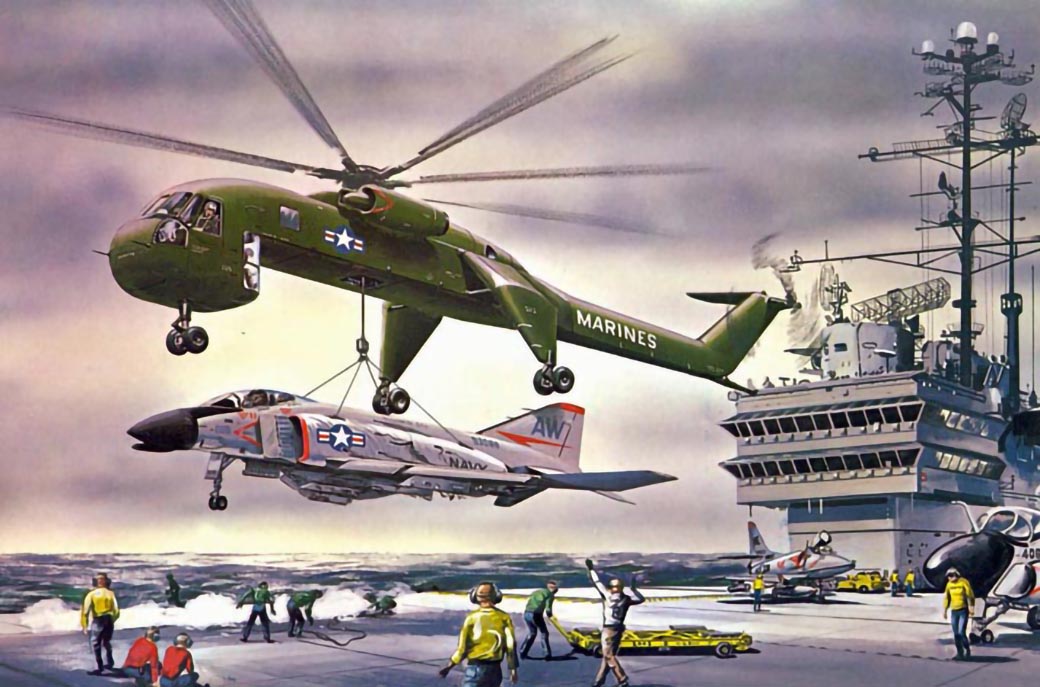
The basic concept of the crane helicopter was extended by the army into the HLH, or Heavy Lift Helicopter. There was a competition for this aircraft between Sikorsky and Boeing Vertol. This was won by Boeing Vertol in 1973 using a tandem rotor configuration. The helicopter used two 92 ft diameter rotors in a tandem configuration and had a gross weight of 118,000 lbs. The program entered design and development but was terminated in 1974 before entering production due to development issues.
Additional Information Sources
SKYCRANE – IGOR SIKORSKY’S LAST VISION, by John A McKenna, retired Sikorsky Executive Vice President. Published by the American Institute of Aeronautics and Astronautics, Inc. in 2010. ISBN 978-1-60086-756-9.
Bill Paul: Reflections on Sikorsky’s 100th Anniversary
Former Sikorsky President Bill Paul reflects on his career with Sikorsky, meeting Igor Sikorsky, and the Sikorsky Aircraft Company’s 100th anniversary.
Sikorsky Lifts the Army
The U.S. Army saw the possibilities of the helicopter early in its development, thus beginning a relationship with Sikorsky Aircraft that continues to this day.
Predictions of a Pioneer
Igor Sikorsky’s predictions for air travel in general and for helicopters in particular have been largely realized or surpassed.
Ray Leoni: Recollections of a Sikorsky Junior Engineer
Ray Leoni recollects his 41-year career at Sikorsky Aircraft, beginning as a junior engineer and retiring as a Senior VP of Engineering and Advanced Programs.
Sikorsky Aircraft Paintings by Andy Whyte
This issue of the newsletter is devoted to the aircraft designs and paintings by Andy Whyte, who had a 40 year career at Sikorsky Aircraft.
How Sikorsky Helicopters Are Named
The subject of this newsletter is in response to an archive member’s question, “How Are Sikorsky Helicopters Named?”
Sikorsky Aircraft in the 1960s
The decade of the 1960s gave birth to the era of Sikorsky turboshaft engine-powered helicopters.